
.jpg?width=40&name=Huma_Profile%20(1).jpg)

Today we're announcing Huma's next chapter. The same mission, pursued at greater scale, with a new identity and a new group of institutional partners.
To accelerate the movement of money for a world that is always on.
We embarked on this mission with two fundamental beliefs:
- Modern payments need modern infrastructure.
- Liquidity is king.
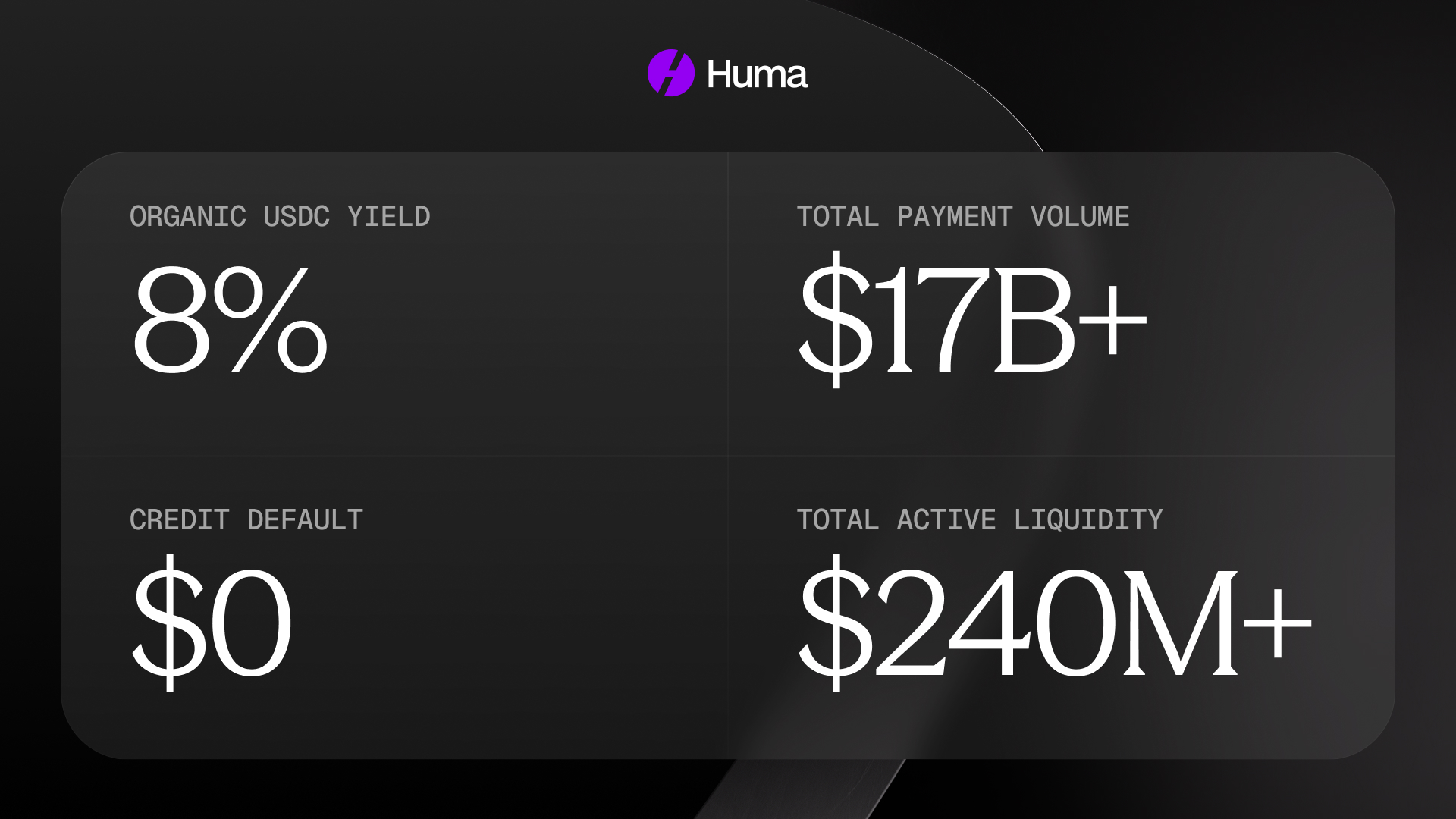
This April marked Huma's fourth anniversary. Since our founding, we've surpassed $17 billion in total transaction volume, and we're now growing by more than $1 billion a month, with zero credit defaults to date.
That's more than 3× year-over-year growth.
That's product-market fit.
Bringing the real economy onchain
A few years ago, no one knew about PayFi. Today it's one of the most sought-after ecosystems, and recent research from Spark identifies payment financing as the third category of onchain credit, alongside traditional asset originators and overcollateralised institutional lending. Huma occupies that third category on its own.
While the applications of payment financing are broad, Huma has built its scale on two major use cases.
Cross-Border Pre-funding. Huma’s primary vertical, powered by its Swiss-regulated entity Arf, provides stablecoin liquidity to licensed payment institutions, enabling T+0 cross-border settlement. Each transactional credit is repaid within one to seven days and is backed by funds already deposited into safeguarding accounts. This stablecoin-based solution can replace fiat prefunding, and it works during weekends and bank holidays, which today's global transaction banking cannot provide.
Trade Finance. In partnership with TradeFlow Capital Management, a Singapore-headquartered specialised investment advisor, Huma finances physical commodities and goods in transit, including rare-earth minerals. These transactions involve legal ownership of the physical cargo, are fully insured, and typically settle within 30 to 90 days. With more commodity traders looking to settle in stablecoins, it is a rapidly growing vertical.

PST’s Next Chapter
PST has matured into an institutional asset. It has surpassed $220M in market capitalisation and ranks as a top-ten tokenized credit asset on rwa.xyz and top three on Solana.
In June 2026 Huma launched its cross-chain platform on Chainlink CCIP and oracles, powering its first Ethereum Morpho market. PST was among the first assets onboarded to Fluid’s Liquidity as a Service platform, and was integrated into RockawayX’s RFQ platform with up to $20M capacity to make looping safer for large liquidity providers. RockawayX, which manages over $2 billion in collective assets and has maintained a zero-default record across CeFi and DeFi lending since 2022, also curates the Huma USDC Main Vault on Morpho.
PST is also independently verified by Accountable, which provides third-party assurance on asset exposure and performance with near real-time visibility. Verification uses onchain proofs, cross-checked against monthly attestations by Swiss audit firm Wadsack.
These developments opened the door to a new set of institutional partners, including Bitwise, Sentora, Galaxy Digital, Coinbase Asset Management, and others. PST is built to scale into a billion-dollar asset.
The new look
Cuneiform is one of the earliest systems humans used to record value and trade, developed around 3200 BCE by the ancient Sumerians in southern Mesopotamia. Our name comes from a different tradition: the Huma, a bird of fortune in Persian legend. One is humanity's oldest record of what is owed, the other an old symbol of what is coming, and Huma finances the distance between them.
Cuneiform's first purpose was accounting for credit and trade: grain owed, debts still to be settled, the type and quantity of goods traded. What made it work was not any single mark. It was that a small, fixed set of them, pressed in combination, could describe any transaction anyone needed to record. Most were written on clay tablets, and the important ones were made permanent by baking them in hot kilns. They have survived for thousands of years. All of this reminds us of the immutable nature of a blockchain, which makes it a natural medium for finance.
Payment financing has needed a vocabulary like that for a long time, so we drew one. The wedge keeps its angle and its pressure, redrawn in vector geometry on a single construction grid: curved negative space, flat terminals, extruded and rendered rather than impressed. Glyphs carry the primitives, from liquidity and yield to T+0 settlement and trade finance, and they compose into the PayFi stack.
We hope you enjoy exploring them as much as we did.
Explore the new site here.
Build on Huma
For licensed payment providers, financial institutions and trade finance orchestrators, Huma is one of the most scalable sources of stablecoin liquidity onchain. Our domain expertise has helped dozens of partners digitise their businesses and scale payment volume without tying up working capital.
For institutional allocators, asset managers and vault curators, Huma's PST is a sustainable source of yield powered by real payment flows, uncorrelated to crypto markets.
Huma, accelerating the movement of money for a world that's always on.